





Blog

ALtools Services
Best Regards, Ifeanyi Nwafor Managing Director Altools Services ? Email: Sales@Altools.ng | Enquiry@Altools.ng | Quotation@Altools.ng ? Phone: +234 706 377 6040 (WhatsApp/WeChat) +234 805 584 2884 ? Address: No. 11 Trans Amadi Industrial Layout, Bedkana Yard, Beside UBA Plc, Port Harcourt, Rivers State, Nigeria ? Website: www.Altools.ng
View More
Altools Services, Provider of Sigma Vacuum Pump
Altools Services is a premier provider of high-quality industrial equipment, specializing in the import, supply, and distribution of a wide range of tools and machinery. Known for their exceptional customer service and reliable products, they offer vacuum pumps, air compressors, power tools, hand tools, and various industrial machinery. Committed to quality assurance, innovation, and sustainability, Altools Services ensures all products meet rigorous standards and incorporate the latest technological advancements. With a robust global distribution network, they serve clients worldwide, helping businesses enhance productivity and efficiency. The Sigma Vacuum Pump B-230 exemplifies their dedication to delivering top-notch industrial solutions
View More
Walker Spark Arrestor Muffler
Safety Precautions Need To Be Observed At Any Point In Time In The Oilfield Environment. Altools Services Presents Walker Universal Exhaust Spark Arrestor.
View More
How to Measure the Density of Gasoline
Measuring the density of gasoline can give you a better understanding of the uses of gasoline for various purposes in different types of engines.
View More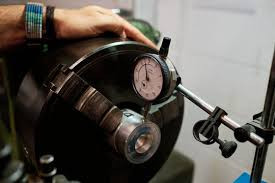
Dial Indicator Types
THE DIAL INDICATOR TYPES There are two main dial indicator types: Lever Dial Test Indicator Plunger Dial Indicator Dial Indicator types: test lever indicatorLever Dial Test Indicator Dial Indicator Types: Plunger IndicatorPlunger Dial Indicator Both dial indicator types have similar features while functioning differently. Understanding the differences in function and the variations in the characteristics of each will help you determine which is the correct instrument for your application. In this article, we go over each indicator type in detail. We discuss functions, features, and their typical applications. Let’s start with Plunger Dial Indicators. PLUNGER DIAL INDICATOR Plunger Dial Indicators (often referred to simply as Dial Indicators) use a plunger that moves in a straight line to magnify and convert the force applied to the contact point (at the bottom of the plunger) into a measurement. FEATURES AND USES Generally larger and heavier than test lever dial indicators, plunger dial indicators are most suited to repetitive, comparative measurements. An example of this is that once set up on a stand or height gauge, plunger dial indicators are great at quickly checking the measurements of a batch of components to ensure they are within the required tolerance. Dial Indicator Types - Baty analogue Plunger Dial Indicators are often used to perform comparative measurements Plunger dial indicators are also often used in machine setups to monitor changes in the alignment of machine parts and components. The plunger dial indicator needs to be positioned at an angle of 90° to function accurately. Using an indicator stand is the best way to do this, with the plunger slotting into a mounting. Plunger dial indicators are also better suited for measuring larger movements than lever dial test indicators, due to cosine error, explained below. LEVER DIAL TEST INDICATOR Lever Dial Test indicators are also known as a lever-type indicator, a DTI or simply a dial test indicator. The bottom of the body houses a pivot with a probe (the lever), its distinguishing feature when visually comparing the two dial indicator types. FEATURES AND USES Lever dial test indicators are more suited for measuring small movements than their larger cousins, for example checking linear and geometric features on a component. Lever indicators are commonly used to measure the amount of material removed during grinding or milling. The lower spring force and angled movement of the lever responds dimensional changes. Generally speaking lever indicators are used to monitor small changes during machining or to measure geometric features such as ovality or runout. Dial Indicator types: test lever indicatorLever Dial Test Indicator The lever contact is used to test the flatness of surfaces PROBE/CONTACT POINT LENGTH AND DIAMETER The length and diameter of the contact point needed will depend on the application. A long thin probe may be required to reach into a narrow recess for example. It is possible to purchase probes/contact points of different sizes for specific uses. However, it is important to use the brands (or brand recommended) products and to calibrate the instrument ready for the new application. Using a length of probe, that the test indicator is not designed to accommodate can cause incorrect magnification of the force, resulting in incorrect measurements/readings. Considering this, buying a lever dial test indicator with a specifically suited probe/contact point for each application is possibly the best bet. The shape, size, and material of the contact point is a consideration discussed later in the article, and is relevant for both dial indicator types. COSINE ERROR A little basic trigonometry (if there’s such a thing!) is required to explain and fix the most common error when using a test lever dial indicator. WHAT IS COSINE ERROR? Before we get into any formulas, let’s explain what causes the error. The test lever dial indicator provides the most accurate measurements when its probe is positioned parallel to the surface of the item being measured, as shown here. test lever position for accurate measurements The contact point of the probe must be parallel to the surface for accurate measurements If it isn’t possible to position the dial indicator parallel to the measuring object then the probe can be angled while the contact point achieves the required parallel position, as shown below. test lever position for accurate measurements The probe is set at an angle from the body of the indicator, keeping the contact point parallel to the surface When the contact point of the measuring probe is not parallel to the measuring surface, it will result in inaccurate measurements, an error known as a cosine error. How not to position a test lever indicator Cosine errors occur when the probe is not parallel to the surface, resulting in inaccurate measurements HOW TO AVOID COSINE ERROR To avoid cosine errors the test lever indicator must be set on a stand and positioned at a 0° angle, ensuring it is parallel or radial to the measuring surface. However, depending on the application, environmental factors such as material position and available space mean this is not always possible. Cosine errors will inevitably occur in some situations, and it is important to know how to adjust for them. HOW TO FIX COSINE ERROR This is where the math comes in. The triangle formed between the contact point/probe and the measuring surface can calculate the amount of error present in the measurement. How to Fix Cosine Error The triangle created between the measuring surface and the contact point can be used to calculate the cosine error We need to know the unknown angle of the right-angled triangle, which is calculated like this: We know the length of the hypotenuse – it is the length of the contact point. We (should) know the length of the adjacent side of the triangle – it is the length of (or part of) the measuring surface. We then calculate adjacent/hypotenuse. We then grab our calculator and hit the ‘cos-1’ key! Now we know the angle we use our calculator again to establish the adjustment we need to make to the measurement. Put the angle into your calculator and push the ‘cos’ key. Multiply the resulting number by the measurement reading, which will give you the correct measurement – simple! Note: We’ve tried to offer a quick and easy to understand calculation explanation. For a full recap on sine, cosine, tangent, and calculating angles check out this great article.
View More
The Beginner's Guide to Pipe Cutters: Materials, Turning, When to Use, and More
Pipe cutters can save you a ton of time once you've got the hang of how to use them. They come in many varieties designed for all sorts of pipe sizes and materials, like copper pipes and PVC pipes, so check the product info before you begin to save yourself some wasted effort with the wrong tool. Below we've answered some of your most common questions about using a pipe cutter to help you out.
View More
How to Read a Tape Measure
Always wanted to know how to take that particularly awkward measurement or how to take care of your tool? Perhaps you're interested in how particular trades use their tools? Then read on... Got a tip to share? Then get in touch!
View More
Measuring With Outside Micrometer
If you are a machinist, manufacturing, or engine professional, exact measurements are an everyday must. When it comes to measuring cylindrical or spherical objects, an outside micrometer would be the best tool to use. A well calibrated micrometer can be difficult to use, but with patience and practice, this tool can be a part of your skill set.
View More
How to Measure the Density of Gasoline
Measuring the density of gasoline can give you a better understanding of the uses of gasoline for various purposes in different types of engines.
View More
8 green laser levels to make sure your measurements are flawless
A green line laser level tool is a construction tool that uses a laser to detect the vertical position of the object. It’s used for measuring distances and heights, as well as for aligning objects on different levels. The green light laser level is basically a handheld device with a built-in laser that emits light in the infrared range. Green line lasers come in a variety of models, including handheld and tripod-mounted lasers. The best option for your site is to compare the features of all the models and choose the one that fits your needs. One thing to consider is how much money you want to spend on the unit. Generally speaking, more expensive units are more accurate but they cost more as well. That being said, let’s take a look at some of the best green light lasers in the market.
View More
The Best ways to Use Digital Tape Measure
A digital tape measure is also called a laser tape measure. It functions by measuring the time that it takes to register a reflected pulse from an outbound laser beam. Working according to the phase shift principle, it instantaneously calculates the distance the beam has traveled
View More
Welcome to shop at Altools Services e-commerce Platform
Altools.ng is Nigeria’s number one online Shopping destination for tools. We pride ourselves in having everything you could possibly need for life and living at the best prices than anywhere else. Our access to Original Equipment Manufacturers and premium sellers gives us a wide range of products at very low prices.
View More
Contact Info
- Address:
- Phone: +2347063776049
- Email: sales@altools.ng

